Read Aramaic English New Testament Online Free
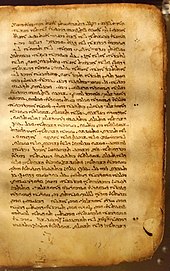
Extract from the Peshitta.
The Aramaic original New Testament theory is the belief that the Christian New Testament was originally written in Aramaic.
The New Attestation in Aramaic languages exists in a number of versions:
- the Vetus Syra (Old Syriac), a translation from Greek into early on Classical Syriac, containing nearly—merely not all—of the text of the 4 Gospels, and represented in the Curetonian Gospels and the Sinaitic Palimpsest
- the Christian Palestinian Aramaic Lectionary fragments represented in such manuscripts every bit Codex Climaci Rescriptus, Codex Sinaiticus Rescriptus, and later lectionary codices (Vatican sir. 19 [A]; St Catherine'southward Monastery B, C, D)
- the Classical Syriac Peshitta, a rendering in Aramaic[ citation needed ] of the Hebrew (and some Aramaic, e.g. in Daniel and Ezra) Old Testament, plus the New Attestation purportedly in its original Aramaic, and still the standard in almost Syriac churches
- the Harklean, a strictly literal translation by Thomas of Harqel into Classical Syriac from Greek
- the Assyrian Modernistic Version, a new translation into Assyrian Neo-Aramaic from the Greek published in 1997 and mainly in use among Protestants
- and a number of other scattered versions in various dialects
Wrote James Holding in 1884, "But He [Christ], their Truthful Shepherd, addressed them [His apostles] in their ain common spoken communication, and where His very words have come up downwardly to united states of america, they demand no translation in the Peshito. Let the reader just dismiss his Greek, until its claim to be the first apostolic Testament can be based on firmer ground than any which we can observe put forward past its boldest supporters. One-sided learning they may exhibit, but, to united states, it appears devoted to trying to prop up a shaky theory."[one]
In 1855, James Murdock quoted Yale College President Ezra Stiles as maxim in his Inaugural Oration, "Kindred with this, [the Hebrew,] or rather a bath-kol, and daughter-vocalisation, is the Syriac, in which the greater part of the New Testament (I believe) was originally written, and not only translated, in the Apostolic age. ... The Syriac Testament, therefore, is of loftier authority; nay, with me, of the same authority as the Greek."[2]
The traditional New Testament of the Peshitta has 22 books, lacking the Second Epistle of John, the 3rd Epistle of John, the Second Epistle of Peter, the Epistle of Jude and the Book of Revelation, which are books of the Antilegomena. Closure of the Church of the East's New Attestation Canon occurred before the 'Western Five' books could be incorporated. Its Gospels text also lacks the verses known every bit Jesus and the woman taken in adultery (John 7:53–8:11) and Luke 22:17–18, but does have the 'long catastrophe of Mark.'[3] [4]
Greek original New Testament hypothesis [edit]
The consensus of mod scholars is that the New Attestation was written in Greek and that an Aramaic source text was used for portions of the New Testament, particularly the gospels.[ citation needed ] They admit that many individual sayings of Jesus as found in the Greek Gospels may be translations from an Aramaic source referred to as "Q source" (from the German language word Quelle), but hold that the Gospels' text in its current grade was composed in Greek, and so were the other New Attestation writings. Scholars of all stripes have acknowledged the presence of scattered Aramaic expressions, written phonetically and then translated, in the Greek New Testament.[ citation needed ]
In an 1887 book, John Hancock Pettingell says "The common impression that the unabridged New Attestation was first written in Greek, and that all the copies we now have, in whatever tongue, are copies, or translations of the original manuscripts, when seriously examined, is establish to accept no certain foundation. And all the same this has been taken nearly universally for granted. It is likely, that this is truthful with respect to some, mayhap a majority of these books. But information technology is more than than likely, if not quite certain, that some portions of the New Attestation, such every bit the Gospel of Matthew, the Epistles to the Hebrews, and others, which will hereafter be mentioned, were offset written in the vernacular Syriac of the Jews, and were later on translated into Greek; and that other portions, possibly most of the books, were duplicated, at the time they were written, by their authors, or nether their direction,—one copy being furnished to those who were familiar with the Greek, and another to those who knew but the Syriac."[five]
An example of how mainstream scholars have dealt with Aramaic influences inside an overall view of the Gospels' original Greek-language evolution may be found in Martin Hengel's synthesis of studies of the linguistic situation in Palestine during the time of Jesus and the Gospels:
Since non-literary, uncomplicated Greek noesis or competency in multiple languages was relatively widespread in Jewish Palestine including Galilee, and a Greek-speaking community had already developed in Jerusalem before long after Easter, one can presume that this linguistic transformation [from "the Aramaic native linguistic communication of Jesus" to "the Greek Gospels"] began very early on. ... [M]issionaries, above all 'Hellenists' driven out of Jerusalem, soon preached their message in the Greek language. We find them in Damascus as early equally Advertisement 32 or 33. A certain per centum of Jesus' earliest followers were presumably bilingual and could therefore report, at to the lowest degree in simple Greek, what had been heard and seen. This probably applies to Cephas/Peter, Andrew, Philip or John. Mark, too, who was better educated in Jerusalem than the Galilean fishermen, belonged to this milieu. The great number of phonetically correct Aramaisms and his cognition of the weather condition in Jewish Palestine compel us to presume a Palestinian Jewish-Christian author. Also, the author's Aramaic native linguistic communication is notwithstanding discernible in the Marcan way.[6]
Aramaic original New Testament hypothesis [edit]
Although concrete bear witness has withal to be found, J.South. Assemane[7] in his Bibliotheca stated that a Syriac Gospel dated 78 A.D. was plant in Mesopotamia.[viii] [ix] [10]
The hypothesis that the New Attestation text that was read past the Apostles would have preserved the life and sayings of Jesus (as he spoke them in Aramaic – the language of Jesus) before it was translated for those not amid them who spoke Greek is not held by the majority of scholars.[ citation needed ]
Syrian churches say that their history includes compilation of their canon (which lacked the 'Western Five') extremely early. Comments John Hancock Pettingell, "There is no question, but that scattered manuscripts of the several books of the New Testament, in Greek, were in existence very early, for the Fathers quote from them,—but there is no show that any endeavour was made to collect them into ane code, or canon, till afterwards the Second or Tertiary Century. But it is certain, on the other hand, that the Syrian Churches had their canon long before this drove was made; tradition says, between the years 55 and 60, and that this was done by the Apostle Jude. This catechism is known to take independent all the books now included in our New Attestation, excepting the Apocalypse, and the brief Epistles of 2d Peter, 2nd and 3d John, and Jude. This tradition is strongly corroborated past the fact that these closing portions of our present canon were not then written; and this is a good and sufficient reason why they were non included in the starting time drove. The abrupt closing of the Book of Acts—for it was plainly written at near that time—that it might be ready for inclusion in this collection, goes to ostend the tradition every bit to the appointment of this collection. The Apocalypse and the four short Epistles which were not in readiness to exist included at that early date, were subsequently received into the Syriac Canon, but not till the sixth century."[11]
The most noteworthy advocate of the "Peshitta-original" hypothesis in the West was George Lamsa of the Aramaic Bible Center. A tiny minority of more contempo scholars are backers of the Peshitta-original theory today, whereas the overwhelming majority of scholars consider the Peshitta New Testament to exist a translation from a Greek original. For example Sebastian Brock wrote:
The merely complete English translation of the Peshitta is by G. Lamsa. This is unfortunately not always very accurate, and his claims that the Peshitta Gospels represent the Aramaic original underlying the Greek Gospels are entirely without foundation; such views, which are not infrequently plant in more popular literature, are rejected by all serious scholars.[12]
(Lamsa and Bauscher did not interpret the Old Testament Peshitta'south deuterocanonical books, merely did translate the remainder of the Peshitta Erstwhile Testament, plus the New Testament. Gorgias Press has published translations of many Peshitta Old Testament books, and of the entire Peshitta New Testament.)
East. Jan Wilson writes, "I believe firmly that both Matthew and Luke were derived from Aramaic originals."[thirteen]
Some advocates of the "Peshitta-original" theory also utilize the term "Aramaic primacy", though this is non used in academic sources. The expression "Aramaic primacy" was used past L. I. Levine,[14] but only equally a full general expression used to denote the primacy of Aramaic over Hebrew and Greek in Jerusalem during the Second Temple period (i.e. roughly 200 BC – 70 Advertisement). The primeval appearance of the phrase in print is in David Bauscher.[15]
Charles Cutler Torrey, while didactics at Yale, wrote a series of books that presented detailed manuscripturial bear witness supporting the Aramaic New Testament, starting with The Translations Fabricated from the Original Aramaic Gospels,[sixteen] and including the widely known Our Translated Gospels.[17]
Brief history [edit]
George Lamsa's translation of the Peshitta New Attestation from Syriac into English language brought the claims for primacy of the Aramaic New Testament to the Westward. Withal, his translation is poorly regarded by nearly scholars in the field.[18] [xix] The Erstwhile Syriac Texts, the Sinai palimpsest and the Curetonian Gospels, have also influenced scholars concerning original Aramaic passages. Diatessaronic texts such as the Liege Dutch Harmony, the Pepysian Gospel Harmony, Codex Fuldensis, The Persian Harmony, The Arabic Diatessaron, and the Commentary on the Diatessaron by Ephrem the Syrian accept provided contempo insights into Aramaic origins. The Coptic Gospel of Thomas and the various versions of the medieval Hebrew Gospel of Matthew likewise accept provided clues to Aramaic foundations in the New Testament particularly the gospels.[ citation needed ] Many 19th Century scholars (H. Holtzmann, Wendt, Jülicher, Wernle, Soden, Wellhausen, Harnack, B. Weiss, Nicolardot, W. Allen, Montefiore, Plummer, and Stanton)[20] [ failed verification ] theorized that portions of the gospels, especially Matthew, were derived from an Aramaic source usually referred to every bit Q.[ dubious ] [ citation needed ]
Statement using the Arabic Diatessaron for the old age of the Peshitta [edit]
Tatian died in A.D. 175. Reasoning and textual evidence propose that Tatian started with the 4 Gospels in the Aramaic Peshitta, and interwove Gospel passages into one consolidated harmonized narrative to go his Diatesseron, in the process quoting three-fourths of the 4 Gospels. We presently lack Tatian'south Diatessaron in its original Aramaic, simply do have information technology in translation in Arabic, a linguistic communication related to Aramaic. A large number of parallels exist between the Peshitta's 4 Gospels and what is in the 'Standard arabic Diatessaron.' Paul Younan says, "It makes perfect sense that a harmony of the Gospels would necessarily require that the distinct 4 Gospels really existed prior to the harmony. This is mutual sense. It makes e'er more sense that an Aramaic harmony of the Gospels, which Tatian's Diatesseron was, was woven together from the 4 distinct Aramaic Gospels. .... Since the Arabic translation by Ibn al-Tayyib is the but one we know for certain was made directly from the Aramaic, and since it reads like the Peshitta..., and since we know that a harmony necessitates a base of 4 singled-out Gospels from which it must be drawn – I submit that Tatian's Aramaic Diatesseron was a harmony of the distinct Gospels in Aramaic we currently discover today in the canon of scripture we know as the Peshitta. Occam'due south Razor is a logical principle which states that one should not increment, beyond what is necessary, the number of entities required to explain anything. In other words, the simplest explanation is usually the best. The simplest explanation is that Tatian created a harmony of the Peshitta gospels. This harmony existed in Persia until at least the 11th century, when it was translated into Arabic. ....if nosotros are to believe the textual evidence in the Standard arabic translation... the Peshitta Gospels were the base of the Diatesseron which history attributes to Tatian. And this places the Peshitta Gospels at or earlier 175 A.D."
The Arabic Diatessaron has been translated into English language, Latin, French, and High german.[21]
Argument from geographical details for the old age of the Peshitta [edit]
Advocates of the Aramaic being written first, and so translated into Greek, have pointed out the geographical details present in the Peshitta, but lacking in Greek mss.; those advocates ask what'due south the best explanation for the presence of those geographical details in the Peshitta, but lacking in Greek mss.
Johann David Michaelis states:[22]
In the Curæ, in Act. Apost. § vi. p. 73, 74. I have taken notice of sure traces in the Syriac version, which lead to the assumption of its having been fabricated by a native Jew. To the reasons alleged in that treatise, which I submit to the determination of my readers, I will add together, that the Syriac translator appears to have been so well acquainted with Palestine, that he must at least accept visited that land, for he has frequently restored geographical names in the Greek Attestation to their true Oriental orthography. Capernaum is written in the Syriac Attestation ... , that is, the hamlet of Nahum; Bethania, is written ... ; Bethphage is written ... , which perfectly corresponds to its situation, for ... , in Arabic, signifies 'a valley betwixt two opposite mountains,' an etymology which alone removes a contradiction which was supposed to exist between the New Testament and the Talmud ; and Bethesda, John five. 2. is written ... , which is probably conformable to the derivation, whether we translate it 'identify of favour,' or 'place of the conflux of waters.' The Syriac version therefore is the surest, and indeed the merely guide, in discovering the etymology of geographical names, for the Arabic versions are also modernistic, and in other translations information technology was impossible to preserve the orthography of the Due east.
William Norton states:[four]
—In the names of places, the Peshito shows the same independence of the Greek. ....in Acts xxi. vii, the Gk. has, Ptolemais; the Syriac has, Acu.
Mr. Jer. Jones, in his piece of work on the Canon, 1798, contends that the apply of the proper noun Acu, for Ptolemais, is a decisive proof that the Peshito must have been made not far in time from A.D. 70, when Jerusalem was destroyed. (vol. i. p. 103.) He says that the well-nigh ancient name of this place among the Israelites was Aco, or Acco, Judges i. 31; that this name was afterwards changed to Ptolemais; that some say it had its new proper noun from Ptolemy Philadelphus, most 250 B.C. He says information technology is certain that the erstwhile proper noun Aco, was antiquated and out of utilize in the fourth dimension of the Romans, and that the apply of the old proper name Acu, in the Peshito, can exist accounted for in no other way, but past supposing that the persons for whom the version was made were more acquainted with it, than with the new name Ptolemais; that upon whatever other assumption it would have been absurd for him to have used Acu. He says, that until the destruction of Jerusalem, i may suppose that the Jews may have retained the old name Aco nevertheless, out of fondness for its antiquity; merely, he says,
"how they, or any other office of Syria, could, after the Roman conquest, call it past a proper name different from the Romans, seems to me impossible to conceive. . . To suppose, therefore, that this translation, in which we encounter with this old name, instead of the new one, was made at any great altitude of time after the destruction of Jerusalem, is to suppose the translator to have substituted an antiquated name known to but few, for a name well known to all" (pp. 104, 105.)
Mr. Jones says that a similar proof that the Peshito cannot accept been fabricated much after A.D. 70, is institute in the fact that the Peshito often calls the Gentiles, equally the Jews were accustomed to do, profane persons, where the Greek calls them the nations, that is, the Gentiles. The Peshito calls them profane, in Matt. vi. 7; 10. 5; 18. 17; Mark vii. 26; John seven. 35; Acts xviii. 4, 17; one Cor. v. ane; x. 20, 27; xii. 2; i Pet. iv. 3. The expression is used, therefore, throughout the Peshito. Mr. Jones says, that it shows that the writer was a Jew, for no other person would have called all the world profane; and that subsequently the devastation of the temple, all Hebrew Christians must have seen that other nations were not to be reckoned unclean and profane in the Jewish sense, and that therefore this version must take been made either before, or soon afterward, A.D. 70. (On Canon, Vol. i., pp. 106–110.)
Argument from bad Greek grammar in Revelation to it not being originally Greek [edit]
Torrey opines that Revelation was originally in Aramaic, and points to grammatical monstrosities as evidence that it was not originally written in Greek:
For the Apocalyptist the language of the New Dispensation of the Christian Church was Aramaic only. It is most significant that the numerous hymns and doxologies sung or recited by the saints and angels in sky, in chapter afterwards affiliate of the volume, are composed in Aramaic (wherever information technology is possible to determine), not in Hebrew; though the writer could have used either language. ....
There is excellent reason, however, for one conclusion he [R.H. Charles] reaches—expressed in like words by many before him—namely, that "the linguistic character of the Apocalypse is admittedly unique." The grammatical monstrosities of the volume, in their number and variety and especially in their startling character, stand alone in the history of literature. It is only in the Greek that they are credible, for information technology is the form, not the sense, that is affected. A few of the more striking solecisms are exhibited here in English translation, so that any reader may see their nature.
1:4. "Grace to yous, and peace, from he who is and who was and who is to come up" (all nom. case). 1:15. "His legs were like burnished contumely (neut. gend., dative instance) every bit in a furnace purified (fem. gend., sing. no., gen. case)" xi:3. "My witnesses (nom.) shall prophesy for many days clothed (accus.) in sackcloth." fourteen:14. "I saw on the deject i seated similar unto a son-of-man (accus.), having (nom.) upon his caput a golden crown." 14:nineteen. "He harvested the vintage of the earth, and cast it into the winepress (fem.), the keen [winepress] (masc.) of the wrath of God." 17:four. "A gilt loving cup filled with abominations (gen.) and with unclean things (accus.)." 19:20. "The lake of blazing fire ("burn down," neut.; "blazing," fem.). twenty:ii. "And he seized the dragon (accus.), the former serpent (nom.), who is the Devil and Satan and jump him." 21:9. "Seven angels, holding the seven bowls (accus.) filled (gen.) with the seven last plagues." 22:v. "They have no need of lamplight (gen.) nor of sunlight (accus.)."
This apparent linguistic chaos has no explanation on the Greek side. Information technology is hardly surprising that to some readers information technology should have seemed open defiance of grammar, to others a symptom of mental aberration. Nevertheless there is method to it all. The more grotesque these barbarisms, the more than certain it is that they are not due to lack of acquaintance with Greek.[23]
Historical criticism [edit]
An argument that at least i of the Greek books of the New Attestation have been translated out of the Aramaic comes from a textual analysis of those attributed to the Apostle John. Their variation in writing way is so considerable, that it would forbid them having been written in Greek by the same author. St Dionysius of Alexandria lent back up to this argument, when pointing out how John'south style of writing differs so markedly between his Gospel and Revelation. He concluded that the sophisticated writer of the former could not accept written the impuissant Greek of the latter. Thus, the merely manner for John to have been the author of Revelation is for information technology to accept been penned by a translator. However, Dionysius himself left open the possibility that it was written in Greek "by a holy and inspired author" other than John.[24]
Some have argued that the Aramaic gospels are older than the Greek gospels, and that the Aramaic NT wasn't derived from the Greek NT. William Norton commented in 1889:[25]
"Faust Nairon, a Maronite, is ofttimes referred to by J. S. Asseman every bit a author of eminence. He was one of the two editors of the edition of the Peshito Syriac Version, printed by the side of an Arabic Version of the N. T., in 1703, by control of the Roman Congregation De propaganda fide, for the use of the Maronites. He also wrote the preface. In this he said, (p. 2.) 'The Syriac text excels in antiquity all other texts. By information technology very many places which in these are obscure, may be made plain.' He proceeds to attempt to evidence that the Syriac text is more ancient than the Greek text of the Gospels. He mentions the common opinion that the Syriac Gospels were translated from the Greek, and says that there are improve reasons for concluding that the Greek Gospels were translated from the Syriac. [....] F. Nairon says in proof that THE PESHITO, AS A WHOLE, IS Non A MERE TRANSLATION OF THE GREEK COPIES, that the number of books in it is different from that of the Greek text, which has 2 Peter, 2 and 3 John, Jude, and Revelation. That the order of books is besides unlike from their order in most Greek copies; for James, 1 Peter, and 1 John, follow the Acts; and that the Greek text has passages which the Peshito has not."
Norton later adds (on p. xlvii):
Persons familiar with the Peshito admit the truth of Faust Nairon's remark, that the Peshito does really sometimes "make clear, things difficult or doubtful in the Greek." (Introduction, p. 9.)
Bishop Walton quotes with blessing the remark of De Dieu, that "the truthful pregnant of phrases which often occur in the N. T., can scarcely be sought from any other source than the Syriac." (Polyg. Prol. xiii. 19.)
J. D. Michaelis says, "the Syriac Version leads us sometimes to only and beautiful explanations, where other help is insufficient." (Marsh's Michaelis, vol. 2. p. 44.)'
Norton mentions (on lix–lx) boosted scholars who had loftier regard for the Aramaic, and gives a fuller exposition of Michaelis:
Jacob Martini was Professor of Theology in the University of Wittenberg, and wrote a preface to the Due north. T. Peshito-Syriac, in which he said, "Information technology is a version, merely of all, it is the beginning and about ancient. . . Information technology is a version, but fabricated either by i of the Evangelists, or at least, of those who . . . had the Apostles themselves present, whom they could consult and hear, respecting many of the more obscure places. To this just, therefore, when some obscurity or difficulty occurs in Greek copies, tin can we safely go. This only, when doubt arises respecting the meaning or translation of any passage, can exist consulted with prophylactic and freedom from fault. By this simply, the Greek Text is truly illustrated, and rightly understood." (Meet Gutbier's Preface to his Syriac N. T., 1663, p. 26.) J. D. Michaelis, in his Introduction to the North. T., 1787, chap, seven., sec. 4., says, "The Syriac Testament has been my constant study." In sec. 8., he says, "The Peshito is the very all-time translation of the Greek Attestation that I accept ever read. Of all the Syriac authors with which I am acquainted, not excepting Ephraem and Bar Hebraeus, its language is the most elegant and pure. . . . It has no marks of the stiffness of a translation, but is written with the ease and fluency of an original." "What is non to be regarded equally a blemish, it differs frequently from the modern modes of explanation; but I know of no version that is so free from error, and none that I consult with so much confidence in cases of difficulty and doubt. I take never met with a single instance where the Greek is then interpreted, as to betray a weakness and ignorance in the translator; and though in many other translations the original is rendered in and then extraordinary a way every bit almost to excite a grin, the Syriac version must be ever read with profound veneration." "The affinity of the Syriac to the dialect of Palestine is so great, as to justify, in some respects, the assertion that the Syriac translator has recorded the deportment and speeches of Christ in the very language in which he spoke." "The Syriac New Attestation is written in the same language [as that of Christ], but in a different dialect, ... in the purest Mesopotamian.".... Professor Wichelhaus, 1850, dwells much on the worth of the Peshito. He calls it, "The most ancient witness, a version most authentic, untouched and untarnished, always transcribed and preserved by the Syrians with the greatest care." (p. 236.) He did non see why, with some few exceptions, it should not be "most similar to the autographs of the Apostles." (p. 264.)
Mistranslations [edit]
Writing in 1936, Charles Cutler Torrey explains that the mistranslation at Jn xiv:two arose from an erroneous vocalization.[26]
See likewise [edit]
- List of English language Bible translations#Modern Aramaic to English translations
References [edit]
- ^ "'Life' in the Syriac Gospels". The Rainbow, a mag of Christian literature. Vol. 21. 1884. p. 209.
- ^ Murdock's Translation of the Syrian New Testament from the Peschito Version. 1855. pp. 499–500.
- ^ The text of the New Testament: an introduction to the critical ... Page 194 Kurt Aland, Barbara Aland – 1995 "It contains 20-two New Testament books, lacking the shorter Catholic letters (ii–3 John, 2 Peter, Jude) and Revelation (besides equally the Pericope Adulterae [John 7:53–8:11[ and Luke 22:17–eighteen)."
- ^ a b Norton, William (1889). A Translation, in English Daily Used, of the Peshito-Syriac Text, and of the Received Greek Text, of Hebrews, James, 1 Peter, and 1 John, With an Introduction on the Peshito-Syriac Text, and the Revised Greek Text of 1881. London: West. K. Flower. Introduction, pages fifty–li: "In the names of places, the Peshito shows the same independence of the Greek. . . . . in Acts xxi. 7, the Gk. has, Ptolemais; the Syriac has, Acu. Mr. Jer. Jones, in his work on the Canon, 1798, contends that the use of the proper name Acu, for Ptolemais, is a decisive proof that the Peshito must have been made not far in time from A.D. 70, when Jerusalem was destroyed. (vol. i. p. 103. ) He says that the most ancient name of this place among the Israelites was Aco, or Acco, Judges i. 31; that this name was afterwards changed to Ptolemais; that some say it had its new name from Ptolemy Philadelphus, well-nigh 250 B.C. He says information technology is certain that the quondam proper name Aco, was blowsy and out of utilise in the time of the Romans, and that the utilize of the old name Acu, in the Peshito, tin can be accounted for in no other mode, but by supposing that the persons for whom the version was fabricated were more acquainted with it, than with the new name Ptolemais; that upon any other supposition it would have been absurd for him to take used Acu. He says, that until the destruction of Jerusalem, one may suppose that the Jews may have retained the old name Aco still, out of fondness for its antiquity; merely, he says, "how they, or any other part of Syria, could, afterwards the Roman conquest, call information technology by a proper noun different from the Romans, seems to me impossible to conceive. . . To suppose, therefore, that this translation, in which nosotros run into with this quondam proper name, instead of the new one, was made at any cracking distance of time afterward the destruction of Jerusalem, is to suppose the translator to have substituted an blowsy proper name known to just few, for a name well known to all" (pp. 104, 105.) Mr. Jones says that a like proof that the Peshito cannot have been fabricated much after A.D. 70, is found in the fact that the Peshito often calls the Gentiles, as the Jews were accustomed to exercise, profane persons, where the Greek calls them the nations, that is, the Gentiles. The Peshito calls them profane, in Matt. vi. 7; x. v; 18.17; Mark vii. 26; John vii. 35; Acts eighteen.4, 17; i Cor. v. 1; x. 20, 27; xii. two; 1 Pet. iv.three. The expression is used, therefore, throughout the Peshito. Mr. Jones says, that information technology shows that the author was a Jew, for no other person would have chosen all the world profane; and that afterwards the destruction of the temple, all Hebrew Christians must have seen that other nations were not to be reckoned unclean and profane in the Jewish sense, and that therefore this version must have been made either before, or presently later, A.D. 70." (On Canon, Vol. i., pp. 106–110.)
- ^ Pettingell, John Hancock (1887). "The Gospel of Life in the Syriac New Testament". Views and Reviews in Eschatology: A Collection of Messages, Essays, and Other Papers Concerning the Life and Death to Come. p. 48.
- ^ Martin Hengel. 2005. "Heart-witness Memory and the Writing of the Gospels: Form Criticism, Customs Tradition and the Potency of the Authors." In The Written Gospel, ed. by Markus Bockmuehl and Donald A. Hagner. Cambridge University Printing. Pp. 89f.
- ^ Assemane, Giuseppe Simone (J.Southward.). "Bibliotheca Orientalis (2nd Vol.) De Scriptoribus Syris Monophysitis". digitale-sammlungen.ulb.uni-bonn.de. p. 486. Retrieved 2019-10-20 .
- ^ Michaelis, Johann David (1793). Introduction to the New Attestation, tr., and augmented with notes (and a Dissertation on the origin and composition of the iii first gospels) by H. Marsh. 4 vols. [in 6 pt.].
- ^ Norton, William (1889). A Translation, in English Daily Used, of the Peshito-Syriac Text, and of the Received Greek Text, of Hebrews, James, 1 Peter, and 1 John: With an Introduction on the Peshito-Syriac Text, and the Revised Greek Text of 1881. W.Thou. Bloom.
This sacred book was finished on Wed., the 18th day of the calendar month Conun, in the year 389.
- ^ Taylor, Robert; Smith, John Pye (1828). Syntagma of the evidences of the Christian religion. Being a vindication of the Manifesto of the Christian bear witness society, against the assaults of the Christian instruction guild through their deputy J.P.South. [in An answer to a printed paper entitled Manifesto &c.]. Repr. p. 32.
This sacred book was finished on Wed., the 18th twenty-four hour period of the calendar month Conun, in the year 389.
- ^ Pettingell, John Hancock (1887). "The Gospel of Life in the Syriac New Attestation". Views and Reviews in Eschatology: A Collection of Letters, Essays, and Other Papers Concerning the Life and Decease to Come up. pp. 53–54.
- ^ Brock, Sebastian P (2006), The Bible in the Syriac tradition, p. 58 . See too Raymond Brown et al., eds., "The Jerome Biblical Commentary" (London, 1970), 69:88 (article "Texts and Versions"), pg. 575: "Claims that the Syr[iac] Gospels are the form in which Jesus spoke his teaching—claims frequently made by people who have every reason to know meliorate—are without foundation."
- ^ xli of his The One-time Syriac Gospels: Studies and Comparative Translations (vol. one, Matthew and Mark) (2003), 381pp.
- ^ Judaism and Hellenism in artifact: conflict or confluence, 1998, p. 82
- ^ The Original Aramaic Gospels in Plain English (2007), p.59.
- ^ Torrey, Charles Cutler (1912). The Translations made from the Original Aramaic Gospels. New York: Macmillan Co. ISBN9781293971314.
- ^ Torrey, Charles Cutler (1933). The Four Gospels: a new translation. New York: Harper & Brothers Publishers.
- ^ Herbert Yard May (October 1958). "Review of The Holy Bible from Aboriginal Eastern Manuscripts, Containing the Old and New Testaments Translated from the Peshitta, The Authorized Bible of the Church of the E". Journal of Bible and Religion. 26 (4): 326–327. JSTOR 1460599. ]
- ^ P.A.H. de Boer (Apr 1958). "Review of The Holy Bible from Aboriginal Eastern Manuscripts past G. Grand. Lamsa". Vetus Testamentum. 8 (ii): 223. doi:10.2307/1516092. JSTOR 1516092.
- ^ Jacquier, Jacque Eugène. "Gospel of St. Matthew." The Catholic Encyclopedia. Vol. 10. New York: Robert Appleton Company, 1911.
- ^ Latin: Tatiani Evangeliorum Harmoniae Arabice nunc primum ex duplici codice edidit et translatione latina; A. Ciasca (1888). French: Diatessaron De Tatien by Tatian; A. South. Marmardji (1935). German language: Tatians Diatessaron aus dem Arabischen (1926). English: Aramaic to Standard arabic to Latin to English: The primeval life of Christ ever compiled from the 4 Gospels : being the Diatessaron of Tatian; J. Hamlyn Colina (1894). English: Aramaic to Arabic to English language: The Ante-Nicene Fathers : translations of the writings of the Fathers down to A.D. 325, volume nine The Diatessaron of Tatian, Hope W. Hogg (1897)
- ^ Michaelis, Johann David (1802). Introduction to the New Testament, tr., and augmented with notes (and a Dissertation on the origin and composition of the three kickoff gospels) past H. Marsh. 4 vols. [in half-dozen pt.]. 4 vols. [in 5 pt.]. Vol. two, part 1 (2nd ed.). pp. 43–44.
- ^ Torrey, Charles C. (1958). "The Apocalypse of John: Introduction, Excerpts, and a New Translation". The Preterist Annal of Realized Eschatology . Retrieved 2 March 2020.
- ^ Eusebius, The History of the Church building. Vii, 24:i–27
- ^ Norton, William (1889). A translation, in English language daily used, of the Peshito-Syriac text, and of the received Greek text, of Hebrews, James, 1 Peter, and 1 John : with an introduction on the Peshito-Syriac text, and the revised Greek text of 1881. Boston University School of Theology. London : W.Thousand. Bloom. pp. xli–xlii, xliv.
- ^ Charles Cutler Torrey, Our Translated Gospels: Some of the Evidence (1936), 108, 113-114
Bibliography [edit]
- Ben-Hayyim, Z. (1957–1977), The Literary and Oral Tradition of Hebrew and Aramaic amidst the Samaritans, Jerusalem Academy of the Hebrew Linguistic communication
- Black, M. (1967), An Aramaic Approach to the Gospels and Acts. 3rd Ed., Hendrickson Publishers
- Burney, C. F. (1922), The Aramaic Origin of the 4th Gospel, Oxford at the Clarendon Press
- Casey, M. (1998), The Aramaic Sources of Marks' Gospel, Cambridge University Printing
- Casey, M. (2002), An Aramaic Approach to Q, Cambridge Academy Printing
- Fitzmyer, J. (1997), The Semitic Background of the New Testament, Eerdmans Publishing
- Lamsa, Thou. (1976), New Testament Origin, Aramaic Bible Eye
- Torrey, C. (1941), Documents of the Archaic Church, Harper & Brothers
- Zimmermann, F. (1979), The Aramaic Origin of the Four Gospels, Ktav Publishing House
External links [edit]
- Dukhrana.com — site contains the transcription of the Khaboris Codex plus Etheridge, Murdock, Lamsa, Younan's interlinear translation of Matthew – Acts 16, translations into Dutch and Afrikaans, and an interlinear written report tool.
- Lamsa – OT and Lamsa – NT — Lamsa's translation of the Peshitta's Former Testament and New Testament
- aramaicdb.lightofword.org — site contains Magiera and Murdock, and an interlinear study tool
- Was the New Testament Really Written in Greek? — a book arguing for Aramaic primacy
- The Composition and Date of Acts (1916) by Charles Cutler Torrey
- Our Translated Gospels: Some of the Show (1936) by Charles Cutler Torrey
- The Origin of the Gospel Co-ordinate to St. John (1923) by James A. Montgomery
bainbridgeyeand1988.blogspot.com
Source: https://en.wikipedia.org/wiki/Aramaic_original_New_Testament_theory
0 Response to "Read Aramaic English New Testament Online Free"
Post a Comment