brainly What geographic advantage shown in this map, led to the defeat of Germany?
Origins of the Cold War
The origins of the Common cold War can be traced through numerous conflicts between the Soviet Union and Western nations, starting with the Russian Revolution in 1917.
Learning Objectives
Summarize the conflicts that led to the Common cold State of war between the United States and the Soviet Spousal relationship
Key Takeaways
Key Points
- The Common cold War between the U.Due south. and Soviet Union originated from postwar disagreements, conflicting ideologies, and fears of expansionism.
- At both the Yalta Conference and Potsdam Briefing, U.S. and Soviet leaders sharply disagreed over the future of the post-war earth.
- After the war, the U.South.' southward primary goal was prosperity through open markets and a strengthened Europe. The Soviet Union sought prosperity through security; a rebuilt Europe would exist a threat. Similarly, the U.S. advocated capitalism while the Soviets advocated communism.
- Both the U.Due south.' s " Long Telegram " and the Soviets' "Novikov Telegram" displayed a sense of mutual distrust.
- Churchill'southward "iron curtain" voice communication and the creation of Cominform further divided the earth into two blocs.
Key Terms
- "atomic number 26 curtain": This term named the imaginary purlieus dividing Europe into two separate areas from the finish of World War Ii in 1945 until the stop of the Common cold State of war in 1991.
- Eastern Bloc: The grouping of communist states of Central and Eastern Europe, by and large including the Soviet Marriage and the countries of the Warsaw Pact.
- Cold War: The period of hostility short of open war betwixt the Soviet Bloc and the Western powers, especially the The states, 1945–91.
- satellite states: A political term for a country that is formally independent, only under heavy political and economic influence or control by another country. The term is used mainly to refer to Central and Eastern European countries during the Cold War that were under the hegemony of the Soviet Union.
- Cominform: Founded in 1947, this was was the common name for what was officially referred to as the Information Bureau of the Communist and Workers' Parties. It was the first official forum of the international communist movement since the dissolution of the Comintern, and confirmed new realities later on World War II, including the creation of an Eastern bloc.
The Cold War nigh directly originates from the relations betwixt the Soviet Union and the allies (the United States, Great Britain, and France) in the years 1945–1947. After this menstruum, the Cold State of war persisted for more than than half a century.
Events preceding the Second World State of war and the Russian Revolution of 1917 fostered pre- World War II tensions betwixt the Soviet Union, western European countries, and the United states of america. A series of events during and after Earth War II exacerbated these tensions, including the Soviet- German pact during the first two years of the war leading to subsequent invasions, the perceived delay of an amphibious invasion of German-occupied Europe, the western allies' back up of the Atlantic Charter, disagreement in wartime conferences over the fate of Eastern Europe, the Soviets' creation of an Eastern Bloc of Soviet satellite states, western allies scrapping the Morgenthau Plan to support the rebuilding of High german industry, and the Marshall Program.
Pre-World War Ii Tensions
As a result of the 1917 Bolshevik Revolution in Russian federation and its subsequent withdrawal from World War I, Soviet Russia found itself isolated in international diplomacy. Leader Vladimir Lenin stated that the Soviet Marriage was surrounded by a "hostile capitalist encirclement," and he viewed diplomacy equally a weapon to keep Soviet enemies divided, beginning with the establishment of the Soviet Comintern calling for revolutionary upheavals abroad. Tensions betwixt Russia (including its allies) and the West turned intensely ideological.
Afterwards winning the civil war, the Bolsheviks proclaimed a worldwide challenge to capitalism. Subsequent Soviet leader Joseph Stalin, who viewed the Soviet Wedlock as a "socialist island," stated that the Soviet Matrimony must encounter that "the present capitalist encirclement is replaced by a socialist encirclement." As early as 1925, Stalin stated that he viewed international politics as a bipolar world in which the Soviet Union would attract countries gravitating to socialism and capitalist countries would concenter states gravitating toward capitalism, while the world was in a period of "temporary stabilization of commercialism" preceding its eventual collapse.
Differences in the political and economic systems of Western democracies and the Soviet Union—socialism versus capitalism, economic independence versus free merchandise, country planning versus private enterprise—became simplified and refined in national ideologies to represent ii ways of life. The atheistic nature of Soviet communism concerned many Americans. The American ethics of costless conclusion and President Woodrow Wilson 's Fourteen Points conflicted with many of the USSR'due south policies.
Alien Postwar Goals
Several postwar disagreements between western and Soviet leaders were related to their differing interpretations of wartime and immediate mail-war conferences. At the February 1945 Yalta Briefing, they could not reach business firm agreements on crucial postwar questions similar the occupation of and postwar reparations from Germany. Given Russia's historical experience of frequent invasions and the immense expiry toll of the war (estimated at 27 million), the Soviet Matrimony sought to increment security by dominating the internal affairs of its adjoining countries. Stalin was determined to utilise the Red Army to proceeds control of Poland, dominate the Balkans, and destroy Frg's capacity to engage in another war. On the other hand, the Usa sought military victory, the achievement of global American economic supremacy, and the creation of an intergovernmental body to promote international cooperation. The key to the U.Southward. vision of security was a postwar world shaped according to the principles laid out in the 1941 Atlantic Charter—a liberal international system based on gratis trade and open markets. This would require a rebuilt capitalist Europe with a good for you Frg at its center to serve once more as a hub in global affairs.
At the Potsdam Briefing in July 1945, the Allies met to decide how to administrate the defeated Nazi Germany. Serious differences emerged over the time to come evolution of Germany and Eastern Europe. At Potsdam, the U.S. was represented by President Harry S. Truman, who relied on a set of advisers who took a harder line toward Moscow than his predecessor Franklin Roosevelt. Under Truman'due south assistants, officials favoring cooperation with the Soviet Spousal relationship and the incorporation of socialist economies into a earth trade system were marginalized. The diminutive bombings of Hiroshima and Nagasaki were in office a calculated attempt on the role of Truman to intimidate the Soviet Wedlock, limiting its influence in postwar Asia. Indeed, the bombings fueled Soviet distrust of the U.Due south. and are regarded by some historians not as just as the closing act of Earth War Ii, simply as the opening salvo of the Cold War.

Potsdam Briefing 1945: Britain Prime Minister Cloudless Attlee, U.Southward. President Harry Truman, and Soviet Premier Joseph Stalin at the Potsdam Briefing, July 1945
U.South.: Prosperity Based in Open up Markets
U.Southward. leaders hoped to shape the postwar earth past opening upwardly markets to international trade. The U.Southward., as the earth's greatest industrial power and one of the few countries physically unscathed past the war, stood to gain enormously from opening the entire world to unfettered trade. The U.S. would take a global marketplace for its exports and unrestricted admission to vital raw materials. Determined to avoid another economic catastrophe like that of the 1930s, U.S. leaders saw the creation of the postwar order as a way to ensure continuing prosperity.
This Europe required a healthy Germany at its center. The postwar U.Due south. was an economic powerhouse that produced fifty% of the world's industrial goods and an unrivaled military machine power with a monopoly on the new cantlet flop. It also required new international agencies: the Earth Bank and International monetary fund, created to ensure an open, capitalist, international economy. The Soviet Spousal relationship opted non to take part.
Soviets: Prosperity Based in Security
The American vision of the postwar globe conflicted with the goals of Soviet leaders, who were also motivated to shape postwar Europe. Since 1924, the Soviet Union placed a loftier priority on its ain security and internal development. After the war, Stalin sought to secure the Soviet Wedlock'due south western edge by installing communist-dominated regimes under Soviet influence in bordering countries, called the Eastern Bloc. During and immediately after the war, the Soviet Union annexed several Eastern European countries as satellite states, a move viewed as expansionist and ambitious by Western powers. Many of these were originally countries effectively ceded to information technology by Nazi Deutschland in the Molotov-Ribbentrop Pact, earlier Germany invaded the Soviet Marriage. These later annexed territories include Eastern Poland, Latvia, Estonia, Lithuania, part of eastern Republic of finland, and northern Romania.
Tensions Abound
In February 1946, U.Southward. diplomat George F. Kennan delivered a memo from his post in Moscow which came to be known as the Long Telegram. The Long Telegram sought to explain recent Soviet beliefs to Kennan'southward superiors in Washington, and further advised a hard line against the Soviets. It argued that the Soviet Spousal relationship was motivated by both traditional Russian imperialism and Marxist ideology, which advocated the expansion of socialism and the toppling of capitalist regimes. In Kennan'due south view, Soviet behavior was inherently expansionist and paranoid, posing a threat to the United states of america and its allies.
That September, the Soviets produced the Novikov Telegram. This telegram, sent by the Soviet administrator to the U.S., portrayed the latter as in the grip of monopolistic capitalists bent on building up military capability "to prepare the conditions for winning globe supremacy in a new state of war." These differing interpretations of international politics in the immediate postwar era set the stage for a succession of diplomatic, economic, and military machine confrontations between the two powers.
On March five, 1946, Winston Churchill gave a speech declaring that an "fe drape" had descended beyond Europe. This metaphorical curtain divided eastward from w, leaving those nations behind it "subject, in one form or another, non just to Soviet influence but to a very loftier and in some cases increasing measure of control from Moscow." To the Soviets, the speech seemed to intended to incite the West to state of war with the USSR, every bit it called for a broad western brotherhood against the Soviets.
In response to perceived western assailment, in September 1947 the Soviets created Cominform to enforce orthodoxy within the international communist move and tighten political control over Soviet satellites through coordination of communist parties in the Eastern Bloc. The Cold War had begun.
The Common cold War Begins
The Cold War began with the formation of the Eastern Bloc, the implementation of the Marshall Plan, and the Berlin Blockade.
Learning Objectives
Contrast competing U.Southward. and Soviet strategies in postwar Europe
Central Takeaways
Central Points
- Tensions betwixt world powers grew as the Soviet Union began to course the Eastern bloc, turning Central and Eastern European countries such as Poland, Lithuania, and Romania into satellite states.
- Western powers viewed Soviet control over the Eastern bloc with suspicion, assertive it demonstrated assailment on the function of the Soviet Matrimony.
- Announced in 1947, the Marshall Plan was the U.s.a.' comprehensive assistance program for Europe. The Soviet Matrimony viewed this plan with suspicion and forbade Eastern bloc states from accepting assistance.
- In June 1948, the Soviet Marriage initiated the Berlin Blockade, which cut off all supply routes to the High german city. In response to the Occludent, Western powers initiated the Berlin Airlift, the success of which eventually ended the blockade.
Key Terms
- Eastern Bloc: The largely Communist countries of the eastern earth, especially Eastern Europe, especially in the Cold War era.
- satellite states: A land that is formally independent, simply under heavy political and economic influence of or command by some other land. The term is used mainly to refer to Fundamental and Eastern European countries during the Cold War, who were "satellites" under the hegemony of the Soviet Union.
- Marshall Programme: The large-scale American program to assist Europe in which the United States gave budgetary support to help rebuild economies later on the finish of World War Ii in order to prevent the spread of Soviet communism.
Superpower Disharmonize
The United states and Soviet Wedlock eventually emerged as the two major superpowers after World War II. The 1956 Suez Crunch suggested that United kingdom, financially weakened by two globe wars, could no longer pursue its foreign policy objectives on an equal footing with the new superpowers without sacrificing convertibility of its reserve currency as a fundamental goal of policy.
Despite attempts to create multinational coalitions or legislative bodies (such every bit the United nations), it became increasingly clear that the U.S. and Soviet superpowers had very unlike visions about what the postwar world ought to expect similar. The two countries opposed each other ideologically, politically, militarily, and economically. The Soviet Union promoted the ideology of communism, characterized by a planned economy and a 1-party land. In contrast, the U.S. promoted the ideologies of liberal commonwealth and the free market.
The division of the world along U.Southward.-Soviet lines was reflected in the NATO and Warsaw Pact armed forces alliances, respectively. Most of Europe became aligned with either the U.s. or the Soviet Union. These alliances implied that these two nations were function of a earth organized into a bipolar balance of ability, in contrast with a previously multi-polar world.
Forming the Eastern Bloc
During the opening stages of World War II, the Soviet Union laid the foundation for the Eastern Bloc by directly annexing several countries as Soviet Socialist Republics that were initially ceded to it by Nazi Germany in the Molotov-Ribbentrop Pact. These included eastern Poland, Republic of latvia, Estonia, Lithuania, part of eastern Republic of finland, and eastern Romania. In Asia, the Red Regular army overran Manchuria in the final month of the state of war and went on to occupy the big swath of Korean territory n of the 38thursday parallel.
The Eastern European territories liberated from the Nazis and occupied by the Soviet military were added to the Eastern Bloc by converting them into satellite states. The Soviet-style regimes that arose in the satellite states non only reproduced Soviet command economies, simply also adopted the barbarous methods employed by Joseph Stalin and Soviet surreptitious constabulary to suppress real and potential opposition.
Following the Allies' May 1945 victory, the Soviets effectively occupied Eastern Europe, while potent U.South. and Western allied forces remained in Western Europe. In Allied-occupied Germany, the Soviet Union, United states of america, Britain, and France established zones of occupation and a loose framework for four-power command. Soviet occupation of Eastern bloc states was viewed with suspicion by Western powers, as they saw this occupation as a sign of Soviet willingness to utilize aggression to spread the ideology of communism.
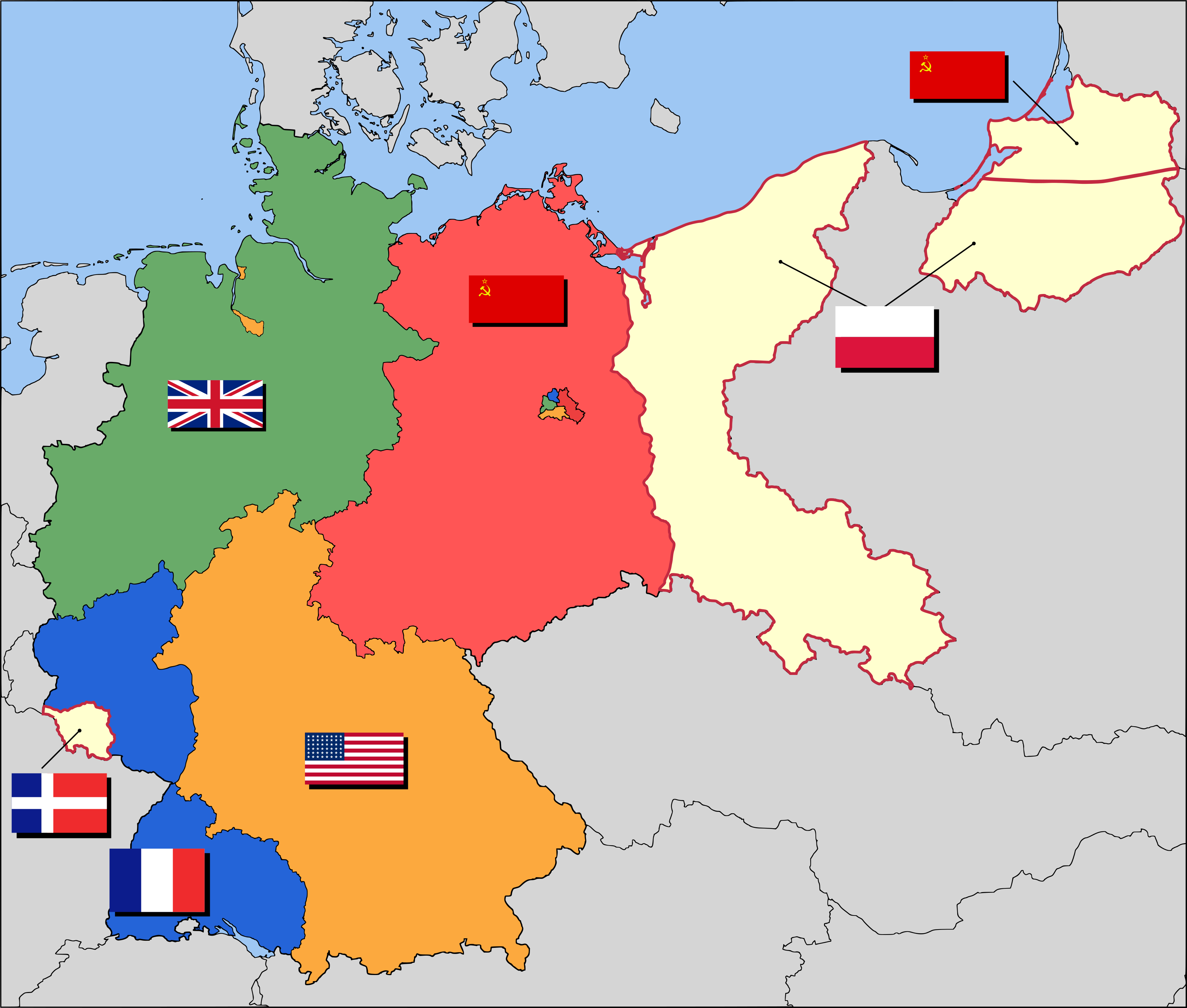
Mail-War Allied Occupation Zones in Frg: Occupation zone borders in Deutschland, 1947. The main Allied powers established zones of occupation in Deutschland after World War II.
The Marshall Plan
In early 1947, Great britain, France and the U.s. unsuccessfully attempted to reach an understanding with the Soviet Union for a plan envisioning an economically self-sufficient Germany, including a detailed bookkeeping of the industrial plants, appurtenances, and infrastructure already removed by the Soviets. In June 1947, in accordance with the Truman Doctrine, the United States enacted the Marshall Plan, a pledge of economic assist for all European countries willing to participate, including the Soviet Union. The program'southward aim was to rebuild the democratic and economical systems of Europe and counter perceived threats to Europe's balance of power, such every bit communist parties seizing control through revolutions or elections. The programme also stated that European prosperity was contingent upon German economical recovery. One calendar month later on, Truman signed the National Security Act of 1947, creating a unified Department of Defense, the Central Intelligence Agency (CIA), and the National Security Council (NSC). These would become the main bureaucracies for U.Due south. policy in the Cold War.
Stalin opposed the Marshall Plan. He had congenital up the Eastern Bloc protective belt of Soviet controlled nations on his Western border and wanted to maintain this buffer zone of states and a weakened Frg nether Soviet control. Fearing American political, cultural, and economical penetration, Stalin eventually forbade Soviet Eastern bloc countries from accepting Marshall Plan aid. Stalin believed that economic integration with the West would allow Eastern Bloc countries to escape Soviet control, and that the U.S. was trying to buy a pro-U.S. realignment of Europe. The Soviet Marriage's alternative to the Marshall programme, purported to involve Soviet subsidies and trade with eastern Europe, became known equally the Molotov Plan.
The Berlin Blockade
As part of the economic rebuilding of Deutschland in early 1948, representatives of a number of Western European governments and the U.s. announced an agreement for a merger of western German areas into a federal governmental system. In addition, in accordance with the Marshall Programme, they began to re-industrialize and rebuild the German economy, including the introduction of a new Deutsche Mark currency to supplant the old Reichsmark currency that the Soviets had debased.
Shortly thereafter, Stalin instituted the Berlin Blockade (June 24, 1948 – May 12, 1949), ane of the first major crises of the Cold War, preventing food, materials, and supplies from arriving in West Berlin. The Soviet Matrimony blocked the Western Allies' railway, road, and canal admission to the sectors of Berlin under Western control. The Soviets offered to driblet the blockade if the Western Allies withdrew the newly introduced Deutsche marker from West Berlin.
In response, the Western Allies organized the Berlin airlift to carry supplies to the people of West Berlin, a difficult feat given the urban center's population. Aircrews from the United States Air Force, the British Royal Air Force, the Majestic Canadian Air Force, the Royal Australian Air Forcefulness, the Purple New Zealand Air Strength, and the South African Air Force flew more than 200,000 flights in 1 year, providing the West Berliners upward to viii,893 tons of necessities such as food and fuel each day. The Soviets did non disrupt the airlift for fear this might lead to open conflict.
By the spring of 1949, the airlift was clearly succeeding, and past April it was delivering more than cargo than had previously been transported into the city past rails. On May 12, 1949, the USSR lifted the blockade of West Berlin. The Berlin Occludent served to highlight the competing ideological and economic visions for postwar Europe.

Berlin Airlift: Berliners watch an shipping accept part in the Berlin Airlift, which was a successful attempt to circumvent the Soviet occludent of non-Soviet Berlin. The Berlin Blockade and the tensions surrounding it marked the beginning of the Cold War.
Containment
Containment was the Cold State of war policy of preventing the spread of Soviet communism (while not confronting it where it already existed).
Learning Objectives
Summarize the U.S. policy of containment, citing specific examples of its application
Primal Takeaways
Key Points
- The Cold War policy of containment was formulated by George Kennan, a State Department official posted in Moscow, in his "Long Telegram."
- President Harry Truman's foreign policy, which came to be known equally the Truman Doctrine, sought to "support free peoples who are resisting attempted subjugation by armed minorities or by outside pressures."
- The Truman Doctrine was followed by a series of measures to contain Soviet influence in Europe, including the Marshall Plan, NATO, intelligence-gathering past the newly formed CIA, and buildup of artillery.
- NSC 68 was a statement of U.S. security policy that argued that a massive military buildup was necessary to accost the Soviet threat.
Key Terms
- détente: A relaxing of tension between major powers, especially the thawing of relations between the Soviet Union and the United States following the Cold War.
- rollback: The strategy of forcing change in the major policies of a state, usually past replacing its ruling authorities. It contrasts with containment, which means preventing the expansion of that state and with détente, which means a working relationship with that state.
- Truman Doctrine: The American policy in 1947 of providing economic and military aid to Hellenic republic and Turkey because they were threatened by communism. It was the beginning of the containment policy to stop Soviet expansion; information technology was a major step in beginning the Cold War.
Policies of Containment
Containment was a U.S. policy that used numerous strategies to forestall the spread of communism abroad. A component of the Cold War, this policy was a response to a series of moves by the Soviet Spousal relationship to enlarge communist influence in Eastern Europe, Communist china, Korea, and Vietnam. It represented a heart-basis position between détente and rollback.
The ground of the doctrine was articulated in a 1946 cable past U.Southward. diplomat George F. Kennan known equally the "Long Telegram." As a clarification of U.S. strange policy, the give-and-take originated in a report Kennan submitted to U.S. Defense Secretarial assistant James Forrestal in 1947, later used in a magazine article. According to Kennan, the Soviet Union did not meet the possibility for long-term peaceful coexistence with the capitalist world. Information technology was its ever-nowadays aim to advance the socialist crusade. Capitalism was a menace to the ideals of socialism, and capitalists could not exist trusted or allowed to influence the Soviet people. Outright conflict was never considered a desirable avenue for the propagation of the Soviet cause, but their optics and ears were always open for the opportunity to take advantage of "diseased tissue" anywhere in the world.

George F. Kennan,1947: George Frost Kennan (February sixteen, 1904–March 17, 2005) was an American adviser, diplomat, political scientist, and historian, best known as "the father of containment" and a key figure in the emergence of the Cold War.
U.S. Presidents and Containment
The word containment is associated near strongly with the policies of U.South. President Harry Truman (1945–53), including the establishment of the North Atlantic Treaty Organization (NATO), a mutual defense pact.
Although President Dwight Eisenhower (1953–61) toyed with the rival doctrine of rollback, he refused to intervene in the Hungarian Uprising of 1956. President Lyndon Johnson (1963–69) cited containment as a justification for his policies in Vietnam. President Richard Nixon (1969–74), working with his top advisor Henry Kissinger, rejected containment in favor of friendly relations (or détente) with the Soviet Spousal relationship and China.
President Jimmy Carter (1976–81) emphasized human rights rather than anti-communism, merely dropped détente and returned to containment when the Soviets invaded Afghanistan in 1979. President Ronald Reagan (1981–89), denouncing the Soviet land as an "evil empire," escalated the Cold War and promoted rollback. Central programs begun under containment, including NATO and nuclear deterrence, remained in effect even after the end of the war.
Containment Under Truman (1945–53)
In March 1947, President Truman, a Democrat, asked the Republican-controlled Congress to appropriate $400 million in help to the Greek and Turkish governments, then fighting Communist subversion. Truman pledged to "back up gratis peoples who are resisting attempted subjugation by armed minorities or past outside pressures." This pledge became known equally the Truman Doctrine. Portraying the event as a mighty clash between "totalitarian regimes" and "costless peoples," the speech marks the onset of the Cold War and the adoption of containment as official U.Due south. policy. Congress appropriated the money.
Truman followed his speech with a series of measures to contain Soviet influence in Europe, including the Marshall Program and NATO, a military alliance between the U.S. and Western European nations.
Because containment required detailed information about Communist moves, the government relied increasingly on the Central Intelligence Bureau (CIA). Established by the National Security Deed of 1947, the CIA conducted espionage in strange lands, some of it visible, about secret. The Soviet Union's commencement nuclear test in 1949 prompted the National Security Quango to formulate a revised security doctrine. Completed in April 1950, information technology became known as NSC 68. It ended that a massive military buildup was necessary to the deal with the Soviet threat.
The Truman Doctrine and the Marshall Programme
The Truman Doctrine was the start of the policy of containment, followed by economical restoration of Europe through the Marshall Programme.
Learning Objectives
Assess the part of the Truman Doctrine and Marshall Plan in the escalating Cold War
Key Takeaways
Primal Points
- The Truman Doctrine was the 1947 American policy of providing economic and war machine assist to Hellenic republic and Turkey because they were threatened by communism.
- The Truman Doctrine was informally extended to get the basis of the Cold State of war policy of containment.
- The Marshall Plan was the Truman Administration's program to rebuild war-torn Europe to forbid the spread of communism, facilitate global trade and complimentary markets, and encourage European peace.
- The U.S. gave $13 billion to European nations through the Marshall Programme.
- The Eastern European countries rejected Marshall Plan aid because of pressure from the Soviet Union, who feared not-communist influence in communist regions.
- The Marshall Plan ended in 1951; many argue that information technology was successful, as it helped European economies grow, prevented the spread of communism, and eventually helped lead to European integration.
Cardinal Terms
- containment: A United States policy using numerous strategies to prevent the spread of communism abroad. A component of the Common cold War, this policy was a response to a series of moves past the Soviet Wedlock to enlarge communist influence in Eastern Europe, China, Korea, and Vietnam. It represented a middle-ground position between détente and rollback.
- Organization for European Economical Co-operation: An intergovernmental organization founded in 1948 to aid administer the Marshall Plan (which was rejected by Soviet Matrimony and its satelite states) by allocating American fiscal assistance and implementing economic programs for the reconstruction of Europe after World War II.
- NATO: An intergovernmental military alliance signed on April 4, 1949. The organisation constitutes a system of collective defense force whereby its fellow member states agree to mutual defense in response to an attack by any external party.
Truman Doctrine and the Greek Civil War
The Truman Doctrine was an American strange policy created to counter Soviet geopolitical spread during the Cold State of war. It was offset announced to Congress by President Harry S. Truman on March 12, 1947 and further adult on July 12, 1948 when he pledged to contain Soviet threats to Hellenic republic and Turkey. American military force was usually not involved, simply Congress appropriated complimentary gifts of fiscal aid to support the economies and the armed services of Greece and Turkey. More generally, the Truman Doctrine implied American support for nations threatened past Soviet communism. The Truman Doctrine became the foundation of American foreign policy and led in 1949 to the formation of NATO, a military brotherhood that is still in consequence. Historians often utilize Truman's speech to date the start of the Common cold State of war.
Truman told Congress that "it must be the policy of the United States to support free peoples who are resisting attempted subjugation by armed minorities or past exterior pressures." Truman reasoned that considering the totalitarian regimes coerced costless nations, they represented a threat to international peace and the national security of the U.s.. Truman made the plea amidst the crisis of the Greek Civil War (1946–49). He argued that if Greece and Turkey did not receive the aid that they urgently needed, they would inevitably fall to communism with grave consequences throughout the region. Because Turkey and Hellenic republic were historic rivals, it was necessary to help both equally even though the threat to Greece was more immediate.
The policy won the support of Republicans who controlled Congress, and $400 million in American money simply no war machine forces were sent to the region. The effect was to end the Communist threat, and in 1952 both countries (Greece and Turkey) joined NATO, a war machine alliance that guaranteed their protection.
Ground for the Policy of Containment
The Truman Doctrine was informally extended to become the basis of American Common cold War policy throughout Europe and effectually the world. Information technology shifted American strange policy toward the Soviet Union from détente (a relaxation of tension) to a policy of containment of Soviet expansion equally advocated by diplomat George Kennan. It was distinguished from rollback by implicitly tolerating the previous Soviet takeovers in Eastern Europe.
The Truman Doctrine underpinned American Cold War policy in Europe and around the globe, and endured considering it addressed a broader cultural insecurity regarding mod life in a globalized earth. It dealt with U.Southward. concern over communism'southward domino effect and mobilized American economical power to modernize and stabilize unstable regions without direct military intervention. It brought nation-building activities and modernization programs to the forefront of strange policy.
The Truman Doctrine became a metaphor for emergency aid to continue a nation from communist influence. Truman used illness imagery not only to communicate a sense of impending disaster in the spread of communism just also to create a "rhetorical vision" of containing information technology by extending a protective shield around non-communist countries throughout the earth.
The Marshall Plan
The Marshall Plan (officially the European Recovery Program) was an American initiative to assist Western Europe, in which the U.s.a. gave $thirteen billion in economic support to assistance rebuild Western European economies after the end of Globe War 2. The initiative was named after Secretarial assistant of State George Marshall. The Plan was largely the creation of State Department officials such as George F. Kennan. The plan was established on June 5, 1947, and was in operation for four years showtime in April 1948.

Marshall Plan Poster: Ane of a number of posters created to promote the Marshall Programme in Europe. Note the pivotal position of the American flag.
Goals of the Plan
The Marshall Plan sought to rebuild a war-devastated region, modernize industry, bolster European currency, and facilitate international merchandise, especially with the United States, whose economic involvement required Europe to go wealthy plenty to import U.Due south. appurtenances. One of the main goals, however, was to contain the growing Soviet influence in Europe and prevent the spread of communism. The Marshall Plan required a lessening of interstate barriers and a dropping of many regulations, and encouraged an increase in productivity, labor union membership, and the adoption of modernistic business procedures.

The Hunger-Winter of 1947: Thousands protestation in Due west Germany against the disastrous food situation (March 31, 1947). Sign: We desire coal, we want bread. The Marshall Plan was designed to assistance rebuild war-torn Europe, and thus brand Europe less susceptible to Communist threats.
Marshall Program and the Soviets
The Marshall Plan offered the same aid to the Soviet Spousal relationship and its allies, but they did non take it as to do so would be to allow a degree of U.S. control over the Communist economies. The non-participation of Eastern Europe was one of the first clear signs that the continent was now divided.
Assistance Amounts
The Marshall Plan aid was divided amid the participant states on a roughly per capita basis. A larger amount was given to the major industrial powers, as the prevailing opinion was that their resuscitation was essential for a general European revival.
During the four years that the plan was operational, $13 billion in economical and technical assistance was given to aid the recovery of the European countries that had joined in the Organisation for European Economical Cooperation. This was on peak of $13 billion in American aid already given.
European Growth Under the Plan
Past 1952 when funding concluded, the economic system of every participant land had surpassed prewar levels; for all Marshall Plan recipients, economic output in 1951 was at to the lowest degree 35% higher than in 1938. Over the next 2 decades, Western Europe enjoyed unprecedented growth and prosperity, but economists are non sure what proportion was directly or indirectly due to the Plan.
Marshall Programme and European Integration
The Marshall Plan was one of the starting time elements of European integration, as it erased merchandise barriers and prepare upwardly institutions to coordinate the economy on a continental level—that is, information technology stimulated the total political reconstruction of western Europe. Many felt that European integration was necessary to secure the peace and prosperity of Europe, and thus used Marshall Plan guidelines to foster integration.
End of the Programme and its Legacy
The Marshall Plan was originally scheduled to end in 1953. Any endeavor to extend it was halted by the growing cost of the Korean War and rearmament. American Republicans hostile to the plan had gained seats in the 1950 Congressional elections, so conservative opposition to the plan was revived. Thus, the plan ended early in 1951, though various forms of American aid to Europe connected.
The political effects of the Marshall Plan may accept been just as important as the economic ones. Marshall Plan aid allowed the nations of Western Europe to relax austerity measures and rationing, reducing discontent and bringing political stability. The communist influence on Western Europe was greatly reduced, and throughout the region communist parties faded in popularity in the years after the Marshall Plan. The trade relations fostered past the Marshall Plan helped forge the Due north Atlantic alliance that would persist throughout the Cold War. At the same time, the non-participation of the states of Eastern Bloc was one of the first clear signs that the continent was at present divided.
North Atlantic Treaty Organization (NATO)
Originally created in response to the Soviet threat, NATO is an intergovernmental common defense force organization.
Learning Objectives
Describe the purpose of the Northward Atlantic Treaty Organization (NATO)
Key Takeaways
Central Points
- NATO was created by the N Atlantic Treaty in 1949, partly as a response to the Soviet Blockade of Berlin.
- The original members of NATO included the Treaty of Brussels members (Belgium, the Netherlands, Luxembourg, France, and the UK), only too added Canada, Portugal, Italy, Norway, Kingdom of denmark, Iceland, and the U.S.
- NATO'due south goal was to be a mutual defence force organization: an armed attack against any member would be considered an attack confronting them all. This provision was stated in Article five of the NATO agreement.
- In its early on years, NATO primarily existed as a political organisation. Withal, the Korean War united NATO members confronting the communist threat, and galvanized the creation of an integrated command structure.
- In 1952, Greece and Turkey joined NATO. In 1954, the Soviet Spousal relationship suggested information technology should bring together, but NATO members refused, fearing the Soviet'due south intentions were to weaken the alliance from the inside.
- When West Germany was integrated into NATO in 1955, the Soviet Marriage responded past forming the Warsaw Pact.
- NATO did not initiate any military machine intervention until after the end of the Cold War, kickoff in Yugoslavia so in Afghanistan.
Key Terms
- Warsaw Pact: A pact (long-term alliance treaty) signed on May 14, 1955, in Warsaw by the Soviet Marriage and its Communist war machine allies in Europe; information technology was comparable and opposed to NATO.
- Korean War: (June 25, 1950 – July 27, 1953) A war betwixt Communist-led N Korea and U.s.-aligned South korea. It was primarily the effect of the political division of Korea past an agreement of the victorious Allies at the decision of the Pacific War at the stop of World War Two.
The N Atlantic Treaty Arrangement (NATO) is an intergovernmental military brotherhood based on the North Atlantic Treaty, which was signed on April four, 1949. The arrangement constitutes a system of commonage defense in which fellow member states agree to mutual defense in response to an assail past whatsoever external party.
NATO'due south headquarters are in Brussels, Kingdom of belgium, one of the 28 member states across North America and Europe. An additional 22 countries participate in NATO'due south Partnership for Peace, with 15 other countries involved in institutionalized dialogue programs. The combined military spending of all NATO members constitutes over 70% of the world'south defence spending.
Beginning of NATO
The Treaty of Brussels, signed on March 17, 1948, by Belgium, holland, Luxembourg, France, and the United kingdom of great britain and northern ireland, is considered the precursor to the NATO agreement. This treaty and the Soviet Berlin Blockade led to the creation of the Western European Wedlock's Defense Organization in September 1948. However, participation of the United States was thought necessary both to counter the military power of the USSR and forbid the revival of nationalist militarism, then talks for a new armed services alliance began virtually immediately. These new negotiations resulted in the North Atlantic Treaty, signed in Washington, D.C. on April 4, 1949. It included the five Treaty of Brussels states plus the U.Due south., Canada, Portugal, Italia, Kingdom of norway, Denmark, and Republic of iceland. This Treaty formally created NATO.
NATO's Purpose
In Article 5 of the lease, the members agreed that an armed attack against whatsoever one of them in Europe or N America would be considered an assail against them all. Consequently, they agreed that if an armed assail occurred, each of them would assist the member existence attacked, taking such activity as information technology deemed necessary, including the use of armed force, to restore and maintain the security of the N Atlantic area. The treaty does non crave members to reply with military action against an aggressor. Although obliged to respond, they maintain the freedom to cull the method by which they do so, although it is assumed that NATO members volition aid the attacked member with military force.
NATO and the Common cold War
During the Cold State of war, doubts over the force of the relationship between Europe and the U.Southward. ebbed and flowed, along with doubts over the credibility of the NATO defense against a prospective Soviet invasion. These doubts led to the evolution of the independent French nuclear deterrent and the withdrawal of the French from NATO's military structure in 1966.
For its starting time few years, NATO was non much more than a political association; the first NATO Secretarial assistant General, Lord Ismay, stated in 1949 that the arrangement'south goal was "to keep the Russians out, the Americans in, and the Germans down." However, the Korean War galvanized the fellow member states, and an integrated armed services structure was built up under the direction of two U.S. supreme commanders.
The outbreak of the Korean State of war in June 1950 was crucial for NATO as it raised the apparent threat of all Communist countries working together and forced the alliance to develop physical armed forces plans. Supreme Headquarters Centrolineal Powers Europe (SHAPE) was formed to direct forces in Europe and began work under Supreme Centrolineal Commander Dwight D. Eisenhower in January 1951. In September 1950, the NATO Armed forces Committee called for an ambitious buildup of conventional forces to meet the Soviets, later reaffirming this position at the February 1952 meeting of the N Atlantic Council in Lisbon. The Lisbon conference sought to provide the forces necessary for NATO's Long-Term Defence force Plan.
In September 1952, the first major NATO maritime exercises began; Exercise Mainbrace brought together 200 ships and more than fifty,000 personnel to practice the defense of Denmark and Norway. Other major exercises that followed included Exercise Grand Slam and Exercise Longstep, naval and amphibious exercises in the Mediterranean Sea; Italic Weld, a combined air-naval-basis practice in northern Italy; One thousand Repulse, involving the British Regular army on the Rhine (BAOR), the Netherlands Corps, and Centrolineal Air Forces Central Europe (AAFCE); Monte Carlo, a simulated atomic air-ground practice involving the Fundamental Army Group, and Weldfast, a combined amphibious landing exercise in the Mediterranean Sea involving American, British, Greek, Italian, and Turkish naval forces.
New Members
Hellenic republic and Turkey joined the alliance in 1952, forcing a series of controversial negotiations over how to bring the two countries into the military control structure. In 1954, the Soviet Wedlock suggested that information technology should bring together NATO to preserve peace in Europe. NATO countries, fearing that the Soviet Union's motive was to weaken the brotherhood, ultimately rejected this proposal.
The incorporation of West Germany into the organization on May 9, 1955, was described as "a decisive turning point" in the history of Europe. A major reason for Germany's entry into the alliance was that without High german manpower, information technology would take been impossible to field enough conventional forces to resist a Soviet invasion.
Warsaw Pact
Ane of the immediate results of Westward Germany'south integration into NATO was the cosmos of the Warsaw Pact, which was signed on May 14, 1955, past the Soviet Union, Republic of hungary, Czechoslovakia, Poland, Bulgaria, Romania, Albania, and E Federal republic of germany. The Warsaw Pact was a formal response to West Germany'south integration and clearly delineated the two opposing sides of the Cold War. While the Warsaw Pact was established as a remainder of power or counterweight to NATO, at that place was no direct confrontation between them. Instead, the conflict was fought on an ideological basis. Both NATO and the Warsaw Pact led to the expansion of military forces and their integration into the respective blocs.

Common cold War European Armed services Alliances Map: During the Cold State of war, most of Europe was divided between ii alliances. Members of NATO are shown in blue, mostly in western Europe plus Greece and Turkey, with members of the Warsaw Pact in red, in eastern Europe.
Post-Cold War NATO
Later the autumn of the Berlin Wall in 1989, the arrangement was drawn into the breakup of Yugoslavia and conducted its first military machine interventions in Bosnia and later on Yugoslavia in 1999. Politically, the organisation sought better relations with former Cold State of war rivals, which culminated with several former Warsaw Pact states joining the alliance in 1999 and 2004.
The September 2001 attacks signaled the just occasion in NATO'southward history when Article v of the North Atlantic treaty has been invoked every bit an set on on all NATO members. After the nine/11 assail, troops were deployed to Afghanistan nether NATO's leadership, and the system continues to operate in a range of roles, including sending trainers to Iraq, assisting in counter-piracy operations, and most recently enforcing a no-fly zone over Libya.
bainbridgeyeand1988.blogspot.com
Source: https://courses.lumenlearning.com/boundless-ushistory/chapter/the-cold-war/
0 Response to "brainly What geographic advantage shown in this map, led to the defeat of Germany?"
Post a Comment